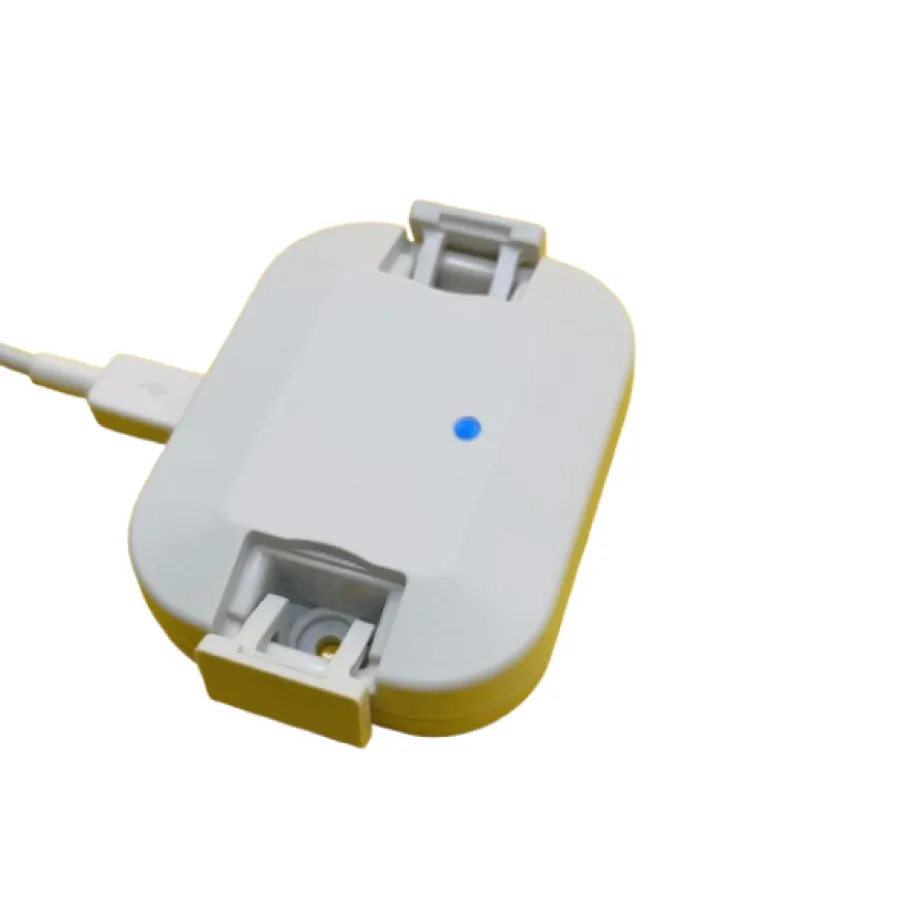
Locator Lite
Compact, low-cost RTLS device for pilots and experimentation — configurable as either an anchor or a tag.
Locator Lite is fully compatible with the firmware of Fieldbus Anchor, therefore can be used for testing and piloting in the same networks.

Interfaces
| Interface | Notes |
|---|---|
| UWB TWR | anchor or tag role |
| UWB TDoA | selected by UWB RTLS method 0x5106 |
| Unified TDMA | schedule parameters 0x71–0x76 |
| BLE GATT | fleet characteristic map |
| GATT Data Sync | 0x5130 / 0x5131 |
| Sensor TLV | produce and decode / forward |
| BLE Ext Advertising | sensor carrier 0x7C = 1 |
| MQTT | WiFi uplink |
| OTA Upgrade | single signed ZIP over BLE; nRF52 and WiFi module |
No CAN or RS-485 controller is fitted; the fieldbus values of the connectivity-mode parameter have no hardware behind them on this model.
Anchor or tag
The role is set with the node mode parameter (0x512D) — 0 for an RTLS anchor, 1 for an RTLS tag — and takes effect after restart. The connectivity-mode parameter (0x511D) is set to WiFi on this model.
Uplink capacity
The WiFi module is a separate chip, joined to the nRF52 by a UART. Every measurement bound for MQTT crosses that link first, so the UART — not WiFi, and not the broker — is usually the first uplink ceiling a deployment meets.
| Bit rate | 115200 baud, 8N1 |
| Throughput | 10 bits per byte → 11 520 bytes/s |
| Wire format | 1-byte command ID + payload + 1-byte CRC |
| Message | Payload | On the wire | Ceiling | Time per frame |
|---|---|---|---|---|
| RTLS — a ranging result | 22 B | 24 B | ≈ 480 /s | ≈ 2.1 ms |
| TDoA observation | 43 B | 45 B | ≈ 256 /s | ≈ 3.9 ms |
The transfer blocks the main loop. The send does not queue and return — it waits for the UART to finish. The time-per-frame column is therefore not just link occupancy, it is main-loop time the device cannot spend on ranging or BLE. Interrupts still run; the loop does not advance.
Locator Lite is not chained, so it carries only its own measurements rather than a chain's — the link is correspondingly less loaded than on a Fieldbus Anchor master, which relays every slave's results across the same UART. The frame costs are identical because the firmware image is the same.
Two things move the ceiling down: TDoA, which costs nearly twice as much per observation (45 bytes against 24), and sensor telemetry, which competes with position data for the same link.
Where a deployment needs measurement rates beyond this, Locator Pro uplinks over Ethernet with no UART stage between the radio and the network.
Related models
- Fieldbus Anchor — same platform with CAN-FD and RS-485 for production chains.
- Vehicle Anchor — same platform in CAS-PDS mode.
- Locator Lite XT — battery-powered reverse-RTLS device on a separate firmware stack.